
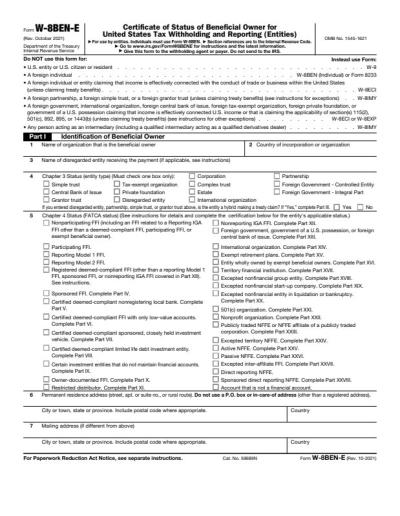
Form W-8BEN-E, filled in online.
Certificate of Status of Beneficial Owner for United States Tax Withholding and Reporting (Entities)
Type in the panel and watch each answer land on the page. Filling in and signing is free; downloading needs a free account, which includes 5 downloads a month.
Or fill it another way:
- Category
- Tax
- Fillable fields
- 179
- Pages
- 8
- Paper size
- US Letter, 8.5 × 11 in
Five ways to fill this form.
-
Fill it in here
Type in the panel and watch it land on the form. Sign it, then download.
Free to fill and sign Start filling -
Many at once, from a spreadsheet
One row per person, one finished PDF for each.
Paid plan · you can walk through it Start with a spreadsheet -
Send it to someone to fill in
Email a link. They fill it in without an account and you get the answers back.
Paid plan · you can walk through it Send a request -
From your own software
Fill it over the API. One request returns the finished PDF.
Paid plan -
Let an AI assistant do it
Connect ChatGPT or Claude once, then describe what goes on the form.
With a free account
Key facts
| Property | Details |
|---|---|
| Form number | Form W-8BEN-E |
| Official name | Certificate of Status of Beneficial Owner for United States Tax Withholding and Reporting (Entities) |
| Issuing agency | Internal Revenue Service (IRS), U.S. Department of the Treasury |
| Current revision | Rev. October 2021 |
| Number of pages | 8 pages |
| Filing frequency | As requested; generally valid until December 31 of the third succeeding calendar year unless a change in circumstances occurs |
| Primary purpose | Document foreign entity status, FATCA classification, beneficial ownership, and treaty claims for U.S. withholding and reporting |
| Related instructions | Instructions for Form W-8BEN-E and Instructions for the Requester of Forms W-8 |
What is this form?
Form W-8BEN-E is the IRS's Certificate of Status of Beneficial Owner for United States Tax Withholding and Reporting (Entities). It is issued by the U.S. Department of the Treasury, Internal Revenue Service, and is used by foreign entities—not individuals—to certify their status for U.S. withholding tax and information reporting. The current IRS form in use is Form W-8BEN-E (Rev. October 2021).
A properly completed form lets a withholding agent, broker, bank, or other payer document that the entity is foreign, determine its chapter 3 and chapter 4 status, and, when applicable, apply a reduced treaty withholding rate instead of the default 30% withholding rate on certain U.S.-source income.
The form is detailed because it combines several tax certifications in one document. Part I identifies the beneficial owner, entity type, addresses, and taxpayer numbers. Part II applies when a disregarded entity or branch receives the payment. Part III is used for treaty claims, including treaty country, limitation-on-benefits status, and special rates and conditions on lines 14 and 15. The remaining parts cover FATCA and chapter 4 classifications such as sponsored FFI, active NFFE, passive NFFE, exempt retirement plan, nonprofit organization, and owner-documented FFI. The form ends in Part XXX — Certification, where an authorized individual signs under penalties of perjury.
Form W-8BEN-E is usually not mailed to the IRS by the entity that signs it. Instead, it is furnished to the payer or financial institution that requested it. That recipient relies on the form to support withholding, Form 1042-S reporting, FATCA due diligence, and—in some cases—documentation for withholding under sections 1446(a) or 1446(f) related to partnership income or transfers of partnership interests.
Who needs to fill this out?
- Foreign corporations, partnerships, trusts, estates, tax-exempt organizations, foundations, banks, insurers, investment entities, and other non-U.S. entities that receive U.S.-source fixed or determinable annual or periodical income such as dividends, royalties, rents, annuities, and certain interest.
- Foreign entities opening or maintaining accounts with an FFI when the bank, broker, payment platform, or other financial institution requests chapter 4/FATCA documentation.
- Foreign entities claiming treaty benefits on Part III, including reduced withholding on dividends, interest, royalties, or certain business profits or gains under an applicable U.S. income tax treaty.
- Foreign partners and transferors in some partnership situations where the form is used for documentation related to sections 1446(a) or 1446(f), including withholding on effectively connected taxable income or certain transfers of partnership interests.
- Foreign sellers or recipients under section 6050Y in situations described by the IRS instructions, except where the entity is a partnership, simple trust, or grantor trust and a different form or documentation rule applies.
- Do not use this form if you are an individual (use Form W-8BEN), if the income is effectively connected with a U.S. trade or business and you are making an ECI claim (generally use Form W-8ECI), or if you are acting as an intermediary, flow-through entity, or certain U.S. branch (generally use Form W-8IMY).
Where and how to submit
Provide Form W-8BEN-E directly to the withholding agent, payer, broker, partnership, bank, or other foreign financial institution that requests it. In most cases, the foreign entity does not file the form with the IRS. There is no general IRS mailing address for routine submission by the beneficial owner because the recipient keeps the form in its records to support chapter 3 withholding, chapter 4/FATCA documentation, backup withholding exceptions, and Form 1042-S reporting. Some institutions accept the form through secure onboarding portals or electronic tax-document workflows if their procedures satisfy IRS rules for electronic signatures and recordkeeping.
The practical deadline is before the payment is made, credited, or account documentation is required. The IRS instructions state that the form should be provided before income is paid or credited to the entity. If the form is not on file when requested, the payer may withhold at 30%, apply 24% backup withholding in cases where backup withholding applies, or apply 10% withholding on the amount realized in certain section 1446(f) partnership-transfer situations. A valid Form W-8BEN-E generally remains in effect from the date signed through December 31 of the third succeeding calendar year, unless a change in circumstances makes the form incorrect sooner.
How to fill it out
- Step 1 — Part I, lines 1-4: Enter the entity's legal name on line 1, country of incorporation or organization on line 2, and any disregarded entity name on line 3 if applicable. On line 4, check the correct chapter 3 entity type, such as corporation, partnership, simple trust, complex trust, grantor trust, tax-exempt organization, or foreign government classification.
- Step 2 — Part I, line 5 and addresses: On line 5, select the entity's chapter 4 (FATCA) status. Then complete the permanent residence or registered address on lines 6 and 7 and the mailing address on lines 8 and 9 if different. Do not use a P.O. box for the permanent residence address unless it is a registered address permitted by the instructions.
- Step 3 — Part I, lines 8-10 and Part II if needed: Provide the U.S. TIN on line 8 if required, the GIIN on line 9a when applicable, the foreign TIN on line 9b, and check line 9c only if an FTIN is not legally required. Use line 10 for reference numbers. If a disregarded entity or branch is the payment recipient, complete Part II with its address, country, and GIIN and check the appropriate branch status box.
- Step 4 — Part III, treaty claims: If the entity is claiming treaty benefits, complete line 14a with the treaty country of residence and line 14b with the applicable limitation-on-benefits category, such as publicly traded corporation, ownership/base erosion test, derivative benefits, or no LOB article in the treaty. On line 15, cite the treaty article and paragraph, the reduced withholding rate being claimed, the type of income, and the additional conditions the entity meets.
- Step 5 — Applicable FATCA certification part: Complete only the certification part that matches the line 5 status. Depending on the entity, this may be Part IV for a sponsored FFI, Part XII for a nonreporting IGA FFI, Part XXV for an active NFFE, Part XXVI for a passive NFFE, or another specific part. A passive NFFE with substantial U.S. owners must also complete Part XXIX.
- Step 6 — Part XXIX when required: If Part XXVI applies and the entity has substantial U.S. owners or controlling U.S. persons, list each owner's name, address, and TIN in Part XXIX. If there are no substantial U.S. owners, certify that fact in Part XXVI instead of leaving the section ambiguous.
- Step 7 — Part XXX, certification: An authorized individual must sign in Part XXX, print their name, date the form, and certify capacity to sign for the entity. Review the form before signing; missing signatures, inconsistent status boxes, or incomplete treaty statements usually cause the payer to reject the form and withhold at the default rate.
Important deadlines & penalties
- Before payment or credit: Furnish Form W-8BEN-E to the withholding agent or payer before U.S.-source income is paid or credited. Waiting until after payment may cause withholding at the default rate.
- General expiration rule: A valid Form W-8BEN-E generally remains effective from the signature date through December 31 of the third succeeding calendar year. Example: a form signed on July 15, 2026 generally remains valid through December 31, 2029, unless facts change earlier.
- Change in circumstances: If any certification becomes incorrect—for example, the entity changes address, entity classification, FATCA status, treaty residence, or ownership—the form must be replaced as soon as the change occurs. Do not wait until the normal expiration date.
- Consequence of missing or late documentation: The withholding agent may withhold 30% on U.S.-source FDAP income under chapters 3 or 4 if valid documentation is not on file.
- Backup withholding exposure: If the payment is one for which backup withholding rules apply and the documentation exception is not established, the payer may apply 24% backup withholding under section 3406.
- Partnership transfer situations: For certain transfers subject to section 1446(f), failure to provide valid documentation can result in withholding of 10% of the amount realized.
- Extensions: There is no separate IRS extension process for Form W-8BEN-E. The practical solution is timely renewal before expiration or prompt replacement after a change in circumstances.
Common mistakes to avoid
- Checking the wrong entity type on line 4: Selecting corporation, partnership, trust, or foreign government status incorrectly can invalidate the form or make the withholding agent request a new one.
- Choosing an inconsistent chapter 4 status on line 5: If the FATCA status box does not match the certification part completed later in the form, the recipient may treat the form as unreliable and apply 30% withholding.
- Leaving line 9b blank without checking line 9c: If a foreign TIN is required, omitting it without indicating that an FTIN is not legally required often causes rejection during account opening or remediation reviews.
- Claiming treaty benefits on line 14a without completing line 14b and line 15 properly: A treaty country alone is not enough. Missing the limitation-on-benefits category, treaty article, withholding rate, or special conditions can cause the claim to be denied.
- Using the wrong form for effectively connected income: If the entity is actually making an ECI claim, using W-8BEN-E instead of Form W-8ECI may result in incorrect withholding treatment and follow-up documentation requests.
- Failing to complete Part XXIX for a passive NFFE: A passive NFFE that has substantial U.S. owners must disclose each owner's name, address, and TIN. Leaving Part XXIX blank can delay onboarding or trigger adverse FATCA treatment.
- Missing Part XXX signature, printed name, date, or capacity: Unsigned or undated forms are not valid withholding certificates, so the payer may ignore the form and withhold at the full statutory rate.
Expert tips
- Start with line 5 before completing later parts: The chapter 4 status on line 5 determines which certification part you must complete. Picking the right status first prevents contradictory answers later in the form.
- Use the legal entity name from formation documents on line 1: Trade names, platform names, or shortened group names often create mismatches with bank KYC records and cause document rejection.
- Review line 9b and line 9c together: Many foreign entities can provide an FTIN, and many institutions expect it. Only check line 9c if the entity is genuinely not legally required to obtain one in its residence jurisdiction.
- For treaty claims, prepare the support for line 14b before you complete Part III: Limitation-on-benefits statements are a frequent review point, especially for holding companies, funds, and subsidiaries claiming reduced dividend rates.
- Keep a diary for renewal: Because the form usually expires on December 31 of the third succeeding calendar year, entities often batch renewals at year-end. Tracking the signature date avoids last-minute withholding problems.
- Use the IRS instructions and Publication 515 together: The form instructions explain line-by-line completion, while Publication 515 gives broader withholding context, including treaty and section 1446 discussions.
- Do a consistency check before signing Part XXX: Confirm that line 4, line 5, Part III, the selected certification part, and Part XXIX all tell the same story. Internal inconsistencies are one of the main reasons requesters send the form back.
Related forms & next steps
- Form W-8BEN — certificate for foreign individuals, not entities. Official IRS page
- Form W-8ECI — used when income is effectively connected with a U.S. trade or business. Official IRS page
- Form W-8EXP — for foreign governments and certain other foreign organizations claiming exempt status. Official IRS page
- Form W-8IMY — for foreign intermediaries, flow-through entities, and certain U.S. branches. Official IRS page
- Form 1042-S — reports U.S.-source income paid to foreign persons and tax withheld. Official IRS page
- Form 1042 — annual withholding tax return for U.S. source income of foreign persons. Official IRS page
- Form 8804 — annual return for partnership withholding tax under section 1446. Official IRS page
- Form 8805 — statement to a foreign partner of section 1446 withholding tax. Official IRS page
Frequently asked questions
What is Form W-8BEN-E used for?
It is used by foreign entities to certify beneficial owner status, foreign status, chapter 4/FATCA classification, and—when applicable—eligibility for reduced U.S. withholding under an income tax treaty.
Do I send Form W-8BEN-E to the IRS?
Usually no. You give it to the withholding agent, bank, broker, customer, marketplace, partnership, or other institution that requested it. That recipient keeps the form in its records.
How long is Form W-8BEN-E valid?
In general, it remains valid from the date signed through December 31 of the third succeeding calendar year, unless a change in circumstances makes any certification on the form incorrect sooner.
What happens if I do not provide Form W-8BEN-E?
The payer may apply 30% withholding on U.S.-source payments, 24% backup withholding where backup withholding rules apply, or 10% withholding on the amount realized in certain section 1446(f) partnership-transfer situations.
Does every foreign entity need a GIIN on Form W-8BEN-E?
No. A GIIN is required only for certain chapter 4 statuses. Many entities, such as active NFFEs and some treaty claimants, do not have or need a GIIN.
Can a foreign company claim treaty benefits on Form W-8BEN-E?
Yes, if it is resident in a treaty country and meets the treaty requirements. Part III must be completed carefully, including line 14a, the limitation-on-benefits representation on line 14b when required, and the treaty article, rate, income type, and special conditions on line 15.
Can I create Form W-8BEN-E in bulk?
Yes. PDFengine supports bulk generation of Form W-8BEN-E via Excel or CSV upload — upload a spreadsheet with one row per entry and PDFengine generates all PDFs at once. You can also automate bulk creation programmatically via the PDFengine API.
Ready to fill it in?
Fill in this formOfficial sources
- Form W-8BEN-E (Rev. October 2021) — official IRS form PDF.
- Instructions for Form W-8BEN-E — official IRS line-by-line instructions and validity rules.
- Instructions for the Requester of Forms W-8 — official IRS requester guidance on validation and withholding agent responsibilities.
- Publication 515, Withholding of Tax on Nonresident Aliens and Foreign Entities — official IRS background on chapter 3 withholding, treaty claims, and section 1446 topics.
- About Form 1042-S — official IRS reporting page for U.S.-source income paid to foreign persons.



